Requirements not met
Your browser does not meet the minimum requirements of this website. Though you can continue browsing, some features may not be available to you.
Browser unsupported
Please note that our site has been optimized for a modern browser environment. You are using »an unsupported or outdated software«. We recommend that you perform a free upgrade to any of the following alternatives:
Using a browser that does not meet the minimum requirements for this site will likely cause portions of the site not to function properly.
Your browser either has JavaScript turned off or does not support JavaScript.
If you are unsure how to enable JavaScript in your browser, please visit wikiHow's »How to Turn on Javascript in Internet Browsers«.


Language / ভাষা:









Editorial
Nostalgia, Education, and Future Leadership: A New Chapter of the Bangladeshi Dream in the Diaspora
- Details

Nostalgia, Education, and Future Leadership: A New Chapter of the Bangladeshi Dream in the Diaspora
By Delwar Jahid
Thousands of miles away from Bangladesh, a new Bangladesh has emerged today in the cities of the United States and Canada—a new generation of Bangladeshi-origin Americans and Canadians. In places like New York, Toronto, Atlanta, Edmonton, Calgary, Vancouver, Dallas, and Macon, wherever Bangladeshi families have settled, an invisible yet deeply emotional world has taken shape—“Home Away from Home.” Within this feeling lie nostalgia, attachment to roots, struggle, sacrifice, education, dreams, and a firm determination to guide the next generation toward a better life and future leadership.
One of the most remarkable characteristics of Bangladeshi immigrants is that they never forget their roots. Even while living abroad, the aroma of semai on Eid mornings, the colors of Pohela Boishakh, memories of village homes, or the busy streets of Dhaka remain vivid in their hearts. Many parents tell their children, “Our country may be small, but its culture, language, and spiritual strength are immense.” This feeling transforms nostalgia from mere emotional memory into a powerful source of identity.
There are clear differences between life in Bangladesh and life in North America. In Bangladesh, family ties, kinship, and social relationships are deeply rooted and emotionally warm. In contrast, life in the United States and Canada is more individualistic, time-conscious, and competitive. Yet Bangladeshi immigrant families strive to combine the best values of both worlds. They teach their children to embrace modern education, science, and technology while preserving humanity, religious values, family traditions, and cultural identity.
One of the greatest dreams of Bangladeshi immigrants is to ensure high-quality education for their children. Many families work tirelessly day after day, take extra shifts, establish small businesses, and overcome numerous hardships solely to secure a brighter future for their children. They believe that education is the greatest asset in life and the most powerful means of developing leadership. Their dream is not limited to earning degrees; rather, they want their children to become responsible citizens, skilled professionals, and compassionate leaders.
Against this backdrop, the experiences of the past two months during a visit across America hold special significance. From Boston to Washington, and from Washington to Macon, Georgia, writing continued throughout the journey, while memorable fishing experiences filled moments of leisure. The silence of nature, long hours spent waiting beside rivers, and precious time with family members brought a sense of peace amid the busyness of immigrant life. Fishing here is not merely recreation; it symbolizes patience, concentration, mental tranquility, and family bonding. For many Bangladeshi immigrant families, such outdoor activities serve as important opportunities to teach children about nature, discipline, and emotional balance.
However, what made the entire vacation most meaningful were two graduation ceremonies. The first was the graduation celebration of Afia Hasan, daughter of Dr. Hasan. Afia’s colorful academic journey and exceptional leadership qualities are exemplary for every young woman. The second was the graduation ceremony of Zarif Rahman, son of Dr. Mahbubur Rahman and Montessori educator Chhobi Rahman, held on May 17, 2026. Each event was attended by more than 150 community members, students, teachers, parents, physicians, engineers, businesspeople, and journalists, creating an inspiring and vibrant atmosphere. The ceremonies began with recitation from the Holy Qur’an and prayers, beautifully highlighting the harmony between education, morality, religious values, and spirituality.
Particular attention was given to the extraordinary achievements of the multi-talented Zarif Rahman. In 2026, alongside becoming the Valedictorian of Stratford Academy, he also received the John Philip Sousa Band Award, National Band Leadership Award, Bibb County Star Student recognition, Scholar Athlete Award, Excellence in Mathematics Award, Mercer University and Habitat for Humanity First Place Holiday Lighting Contest Award, and the prestigious Haynie Award. Zarif’s accomplishments are not only a source of pride for one family; they demonstrate how proper guidance, family values, discipline, and education can elevate a young person to positions of leadership. Likewise, the achievements of students like Zaria and Zarif provide valuable lessons for parents and educators in Bangladesh.
Graduation ceremonies of this kind in the United States and Canada are not merely social events; they mark an important beginning of confidence, responsibility, and future leadership for students. The collective presence of family, teachers, and community members plants seeds of self-esteem and inspiration in young minds. Students begin to realize that education is not only for personal success but also essential for the welfare of society and humanity.
Of course, the reality of immigrant life is not easy. Language barriers, cultural adaptation, identity struggles, racism, and economic uncertainty are all part of their journey. Yet despite these challenges, Bangladeshi families remain hopeful. They believe that through hard work, honesty, and education, even the impossible can become possible. Today’s Bangladeshi-American and Bangladeshi-Canadian youth embody that dream. They are proving their abilities in medicine, engineering, technology, law, business, research, media, and politics. At the same time, they are carrying forward the Bengali language, culture, and identity while creating new examples of leadership in multicultural societies.
Thus, nostalgia is not merely a memory of the past; it is a force that keeps people connected to their roots. “Home Away from Home” is not just an emotion; it is a history of struggle, a journey of dreams, and a noble process of building future leadership. These individuals who rose from the soil of Bangladesh have proven that wherever they may live, through education, values, culture, and humane leadership, they can help make the world more beautiful, prosperous, and compassionate.
==============
#BangladeshiDiaspora
#HomeAwayFromHome
#BangladeshiAmerican
#BangladeshiCanadian
#DiasporaStories
#EducationMatters
#FutureLeadership
#GraduationCelebration
#BangladeshiCommunity
#ImmigrantJourney
#NostalgiaAndIdentity
#LeadershipDevelopment
#BanglaCulture
#ProudBangladeshi
#StudentSuccess
#Valedictorian
#YouthLeadership
#FamilyValues
#BangladeshToAmerica
#BangladeshToCanada
#MulticulturalLeadership
#AcademicExcellence
#CommunityInspiration
#NextGeneration
#BangladeshiYouth
#CulturalIdentity
#DreamsAndDetermination
#SuccessStories
#BanglaHeritage
#InspiringGenerations
Bangladesh’s Culture of Impunity: A Structural Crisis for the Rule of Law, Human Rights, and the Democratic State System
- Details
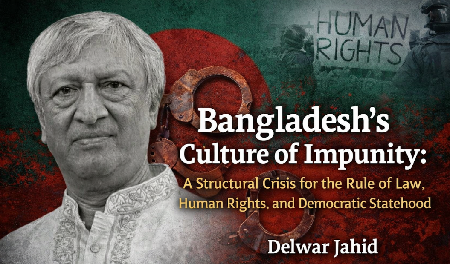
In Bangladesh, the culture of impunity has long posed a grave challenge to state governance, the protection of human rights, and the rule of law. Despite recurring allegations of political violence, extrajudicial killings, enforced disappearances, corruption, and abuse of administrative power, perpetrators have frequently escaped meaningful accountability. This article traces the origins and evolution of this culture of impunity within Bangladesh’s historical and contemporary political context, examining its corrosive impact on democratic institutions. Drawing upon international human rights standards, it also outlines the institutional reforms required to dismantle the system that sustains impunity.
Defining the Culture of Impunity
Impunity refers to a condition in which individuals who commit human rights violations or serious crimes evade legal accountability. Within international human rights law, widespread impunity serves as a stark indicator of a state’s failure to uphold its fundamental legal and moral obligations.
Bangladesh’s experience reveals how the centralization of power, weak institutional frameworks, and a politicized judiciary have entrenched this pattern. As a result, the mechanisms designed to safeguard human rights and enforce accountability have been systematically weakened.
Historical Context
Following independence in 1971, Bangladesh entered a period of political turbulence and military intervention. The political upheaval of 1975 profoundly altered the balance of state power and entrenched a political culture in which justice often remained elusive.
During subsequent decades of military and authoritarian rule, numerous allegations surfaced—ranging from political repression and human rights abuses to administrative corruption. Yet few perpetrators were held accountable. This enduring failure to enforce justice gradually eroded institutional legitimacy and normalized impunity at all levels of governance.
The Continuum of Human Rights Violations and Impunity
Over the past two decades, national and international human rights organizations have repeatedly documented persistent violations, including:
Enforced disappearances
Extrajudicial killings
Political violence
Abuse of power by law enforcement agencies
Investigations into these violations are often delayed, obstructed, or compromised by political interference, rendering justice elusive. Consequently, public confidence in state institutions—especially in law enforcement and the judiciary—has been severely undermined.
Impact on the Democratic System
The culture of impunity undermines the very foundation of a democratic state by corroding its three essential pillars:
Rule of Law — When powerful individuals stand above the law, the principle of equality before the law collapses.
Accountability — When institutions fail to investigate or prosecute wrongdoing, the architecture of democratic oversight disintegrates.
Public Trust — The denial of justice breeds cynicism and alienation, eroding citizens’ faith in the state and its institutions.
International Human Rights Obligations
Under international human rights law, states hold three core responsibilities:
To conduct prompt, impartial, and effective investigations into alleged violations
To prosecute perpetrators and ensure genuine legal accountability
To provide adequate remedies and reparations to victims
Failure to meet these obligations not only violates international legal standards but also undermines a state’s broader moral and constitutional legitimacy.
Philosopher Ibn Taymiyyah’s Theological Thought: Modern Warfare and the Bleeding of Hearts By Delwar Jahid
- Details

On the eve of the Eid festival, I suddenly traveled from Canada to Boston in the United States. It was a departure from the routine cycle of daily life—an entirely different journey. Amid global conflicts, wars, and political uncertainties, I found myself searching for a sense of inner peace—an emotional and psychological balance that allows a person to remain composed despite external turmoil.
This peace does not mean a life free from crisis; rather, it is the strength to remain steady in the face of adversity. Self-awareness, acceptance, clarity of life’s purpose, and harmony between thought, emotion, and action—these are the true sources of innerpeace.
Participatory and Inclusive Elections in Bangladesh: The Final Test of Public Trust
- Details

Participatory and Inclusive Elections in Bangladesh: The Final Test of Public Trust
By Delwar Jahid
Democracy is not merely a procedural exercise; it survives on public trust. That trust is born through elections in which citizens believe their votes matter and their voices are heard by the state. When trust collapses, even a constitutionally valid election fails to ensure stability or security. Bangladesh now stands at precisely such a crossroads.
- Additional Resources:
- Additional Resources:
- Agro-Ocean
- Asian News and Views
- Bangabandhu Development and Research Institute
- Bangladesh North American Journalists Network
- Bangladesh Heritage and Ethnic Society of Alberta (BHESA)
- Coastal 19
- Delwar Jahid's Biography
- Diverse Edmonton
- Dr. Anwar Zahid
- Edmonton Oaths
- Mahinur Jahid Memorial Foundation (MJMF)
- Motherlanguage Day in Canada
- Samajkantha News
- Step to Humanity Bangladesh