Requirements not met
Your browser does not meet the minimum requirements of this website. Though you can continue browsing, some features may not be available to you.
Browser unsupported
Please note that our site has been optimized for a modern browser environment. You are using »an unsupported or outdated software«. We recommend that you perform a free upgrade to any of the following alternatives:
Using a browser that does not meet the minimum requirements for this site will likely cause portions of the site not to function properly.
Your browser either has JavaScript turned off or does not support JavaScript.
If you are unsure how to enable JavaScript in your browser, please visit wikiHow's »How to Turn on Javascript in Internet Browsers«.


Language / ভাষা:









Contemporary
Man Dies After Hours-Long ER Wait in Edmonton, Family Demands Accountability
- Details

Man Dies After Hours-Long ER Wait in Edmonton, Family Demands Accountability
The death of a 44-year-old Edmonton man after an extended wait in a hospital emergency department has sparked renewed concerns about emergency care delays, accountability, and potential systemic failures in Alberta’s health system. Prashant Sreekumar died on December 22 at Grey Nuns Community Hospital after arriving at the emergency room earlier that day with severe chest pain.
According to his family, he underwent an electrocardiogram (ECG) and blood tests shortly after arrival, both of which reportedly showed no immediate abnormalities. Despite continuing and worsening symptoms, he remained in the emergency waiting area for nearly eight hours before being taken into a treatment room, where he collapsed and died shortly afterward.
His wife, Niharika Sreekumar, describes repeated attempts by her husband to alert hospital staff to the severity of his condition. She says he experienced extreme pain, difficulty breathing, vomiting, dizziness, and dangerously high blood pressure during the wait. Despite these symptoms, the family was told his condition was not considered “acute” compared to other patients and that longer wait times were standard. The sudden death has left the family devastated emotionally and financially.
The couple has three children, including one who requires round-the-clock care. Although both spouses are accountants, Prashant was the sole earner for the household. His wife is now facing an uncertain future while grieving what she describes as a preventable loss. Beyond personal tragedy, the family is demanding answers and accountability, questioning whether negligence—or even racial bias—played a role in the handling of Prashant’s case. They argue that as Canadian citizens and taxpayers, they expected timely and adequate medical care in a life-threatening situation.
Alberta Health Services reports that average emergency wait times at Grey Nuns Hospital are just over three and a half hours, though individual waits can be significantly longer. Covenant Health, which operates the hospital, confirmed that the case is under review and has been referred to the Office of the Chief Medical Examiner. Officials say they are unable to comment on specific details while the investigation is ongoing, but have expressed condolences to the family. The case has intensified public debate about emergency room overcrowding, triage practices, and patient safety, raising broader questions about whether current systems are adequately equipped to recognize and respond to critical symptoms before it is too late.
UNESCO’s Joint Celebration of Mujib Barsho hailed by Bangabandhu's Bangladesh
- Details
Edmonton (Canada), November 28, 2019: The decision made by UNESCO to celebrate Mujib Borsho (Year) together with Bangladesh is a well-deserved success and a step forward to brand Bangabandhu's Bangladesh throughout the world.
Board President of Bangabandhu's Bangladesh, Executive of the Bangaladesh Muktijudha Sangshad Canada Unit Command and editor of Diverse Edmonton Delwar Jahid issued a commendation to UNESCO and Bangladesh Government for this joint effort of celebrating Mujib Year.
The idea to celebrate Mujib Year from March 17, 2020- March 26, 2021 through various programmes making the birth centenary of Father of the nation Bangabandhu Sheikh Mujibur Rahman.
UNESCO made the unanimous decision at its 40th general Assembly on November 25 2019 held at UN body's HQ in Paris.
By this decision UNESCO has created an environment of a worldwide observance of Mujib Year to promote multiculturalism, awareness of political culture and diversity.
For the launch of this year theme Jahid proposed Bangabandhu's Bangladesh to be an agenda and appeals for the acknowledgement. Generally, UNESCO reiterates its commitment to diversity and invites its member states to celebrate the day. Jahid urges to the Canadian Federal, provincial, municipal, educational and communities to celebrate the day.
Commercial farming of arum gains momentum in Rajshahi region
- Details
By Dr Aynal Haque
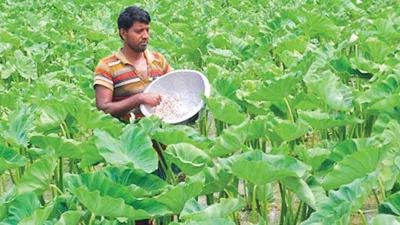
RAJSHAHI, Aug 16, 2015 (BSS)- In the wake of gradually increasing demand and lucrative market price, cultivation of arum has brought smiles on the faces of farmers in Rajshahi region including its vast Barind tract as they are getting good profit by cultivating it on their lands.
Locally known as 'Latiraj', arum is a favourite vegetable of many people.
Arum cultivation has brought fortune for many farmers in the region with its bumper production and high profit this season.
The good arum harvest has been attributed to suitable soil, favourable
weather and necessary help from the local agriculture offices.
A section of farmers in the region have started growing arum commercially as it has become a profitable crop and cultivation costs are low.
The farmers are now cultivating arum on commercial basis. Different
varieties of arum are cultivated in the region. Almost all the varieties are grown in the water-logged areas.
Hazrat Ali, Deputy Director of the Department of Agriculture Extension said "Arum is an environment-friendly, poison-free and nourishing crop. The agriculture department has been advising farmers on cultivating arum of the high yield variety."
Different varieties of arum are cultivated in the region including white and red colour. Almost all the varieties are grown in the water-logged areas. The cultivation of Latiraj variety is gaining popularity among the farmers as it is about five times more profitable than paddy farming.
As it requires little nursing, the risk of arum cultivation is also little.
Even fertilisers are not necessary for its growth. So, farmers are cultivating arum on a large scale because of high financial return from the crop, he says.
"Latiraj variety of arum is plated early January. The harvest starts in mid-April and the yield continues for eight months till mid-December. A farmer gets 3 to 5 maunds of yield from each decimal of land," said Jahid Hossain, arum grower at Duary village of Paba upazila.
"Over 500 hectares of land for Mukhi Kachu and over 150 hectares for Pani Kachu have been used for cultivation of arum in the district this year. We advise farmers to cultivate Pani Kachu in marshlands where other crops do not grow well. Arum cultivation is increasing here every year, and farmers are
becoming self-reliant," said Ali.
Disappointed over low price of paddy, jute and other crops many farmers of the region became interested in the cultivation of arum and some other vegetables in recent years and its cultivation proved lucrative.
Sazdar Rahman, 47, an arum farmer of Rajabari village of Durgapur, said "I have cultivated arum of the mukhi variety on five bighas of raised land and am expecting bumper production. I planted the arum seed in the third week of January and harvest began in the third week of July."
"The variety grows well on land with good drainage. I am a vegetable farmer,but I have been cultivating arum for some years and getting better profits at lower costs," said Rahman.
He said farmers use only some organic fertiliser during arum cultivation and they do not need to use insecticides. Farmers face few problems in growing this vegetable. Cattle do not eat arum plants and labour is not required to look after it.
Saidur Rahman of Parila under Paba upazila in the district said he
cultivated Taro Arum (Mukhi Kachu or Boi Kachu) and achieved an excellent yield of the crop this season. He said adding that a farmer can get 2-3 maund of Taro Arum from each decimal of land.
Joynal Abedeen of Palpur village in Godagari upazila said, he has cultivated Creeper Arum (Loti Kachu) on two bigha of land this season. He has already
earned Tk 22,000 and is expecting more profit during rest of the season.
"I can buy adequate fresh vegetables including arum from different wholesale markets in Rajshahi city and its outskirts at cheaper cost," said Aminul Islam a trader from Dhaka.
At present 1Kg of Latiraj variety arum sells for Tk18-20 at the local market and the price is expected to double after two to three months. This vegetable is in high demand as it is tastier and more nourishing than all other vegetables.
Dr Khalilur Rahman, Associate Professor of Medicine in Rajshahi Medical College Hospital, described arum as nourishing and tasty vegetable. This vegetable works as a remedy for different diseases, especially diabetics, he claimed.
Fazlur Rahman, Additional Director of Department of Agriculture Extension (DAE), said, the farmers of the region are expected to grow huge quantity of arum and other vegetables this year as they prefer cultivating vegetables to other crops. Use of modern technology and quick compost has enhanced the production of vegetables significantly, he added.
Expressing contentment a number of farmers said it was difficult for them to afford the expenses of their family by growing paddy only; but cultivation of arum and other vegetables is now giving them adequate profit to ease their financial constraints.
- Additional Resources:
- Additional Resources:
- Agro-Ocean
- Asian News and Views
- Bangabandhu Development and Research Institute
- Bangladesh North American Journalists Network
- Bangladesh Heritage and Ethnic Society of Alberta (BHESA)
- Coastal 19
- Delwar Jahid's Biography
- Diverse Edmonton
- Dr. Anwar Zahid
- Edmonton Oaths
- Mahinur Jahid Memorial Foundation (MJMF)
- Motherlanguage Day in Canada
- Samajkantha News
- Step to Humanity Bangladesh